
The complete guide
How To Choose And Fit An Appliance Drain Hose Extension
When the hose will not reach
It usually comes up during a move or a new kitchen. The washing machine goes into its space, you reach behind for the grey hose, and it stops well short of the standpipe. Or the dishwasher has been shifted to the far side of the sink and its hose now has to cross a whole cupboard to get to the trap.
The hose supplied with an appliance is a standard length. It is long enough for a machine that stands right beside its waste. Anything else needs more hose.
People try all sorts to bridge the gap. A length of garden hose pushed over the end. Tape. A hose stretched so tight it lifts out of the standpipe on the spin cycle. Each of these ends the same way, with waste water across the floor and under the units.
The proper answer is a drain hose made for the job, joined with a fitting made for the joint, and clamped.
What is in this kit
There are four kinds of part.
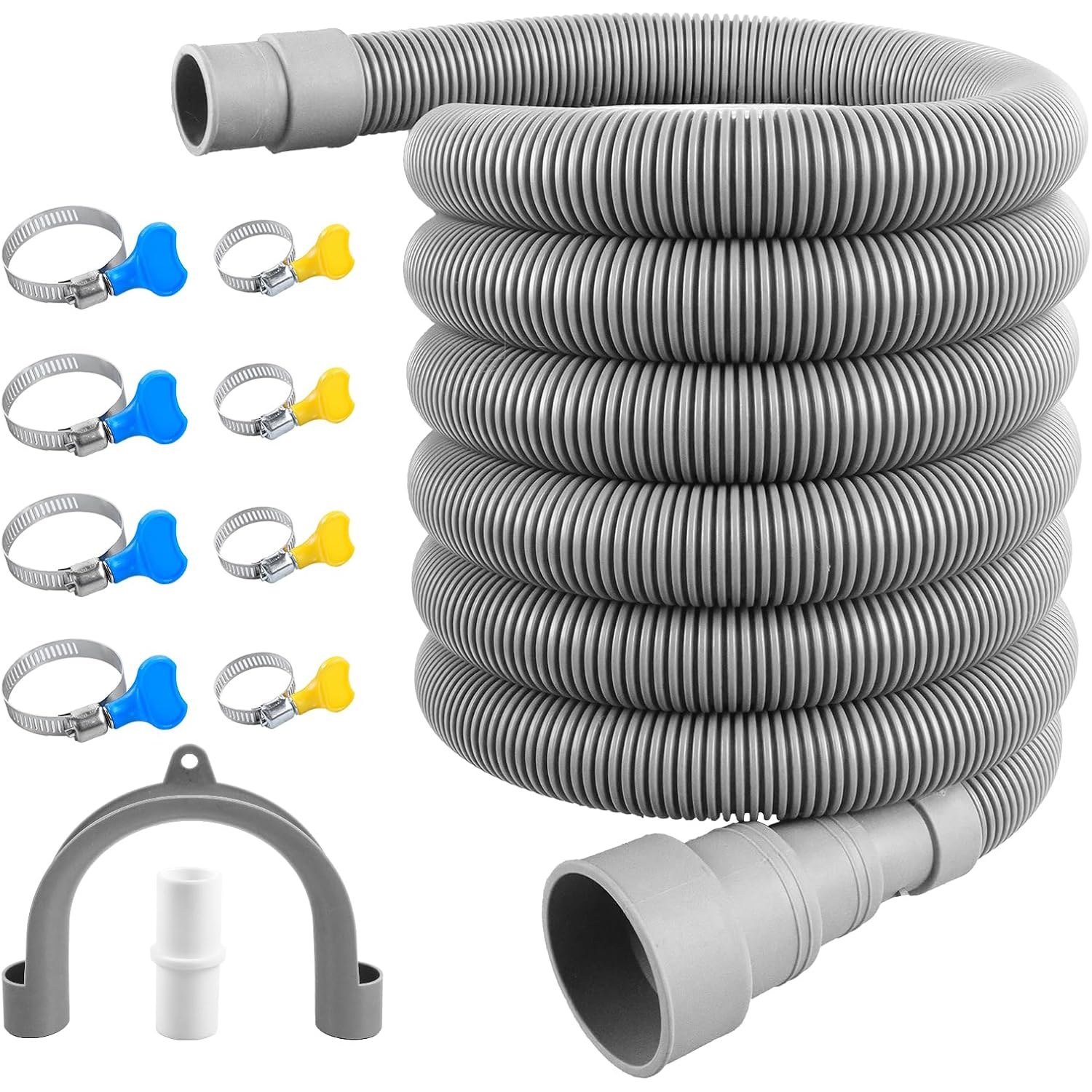
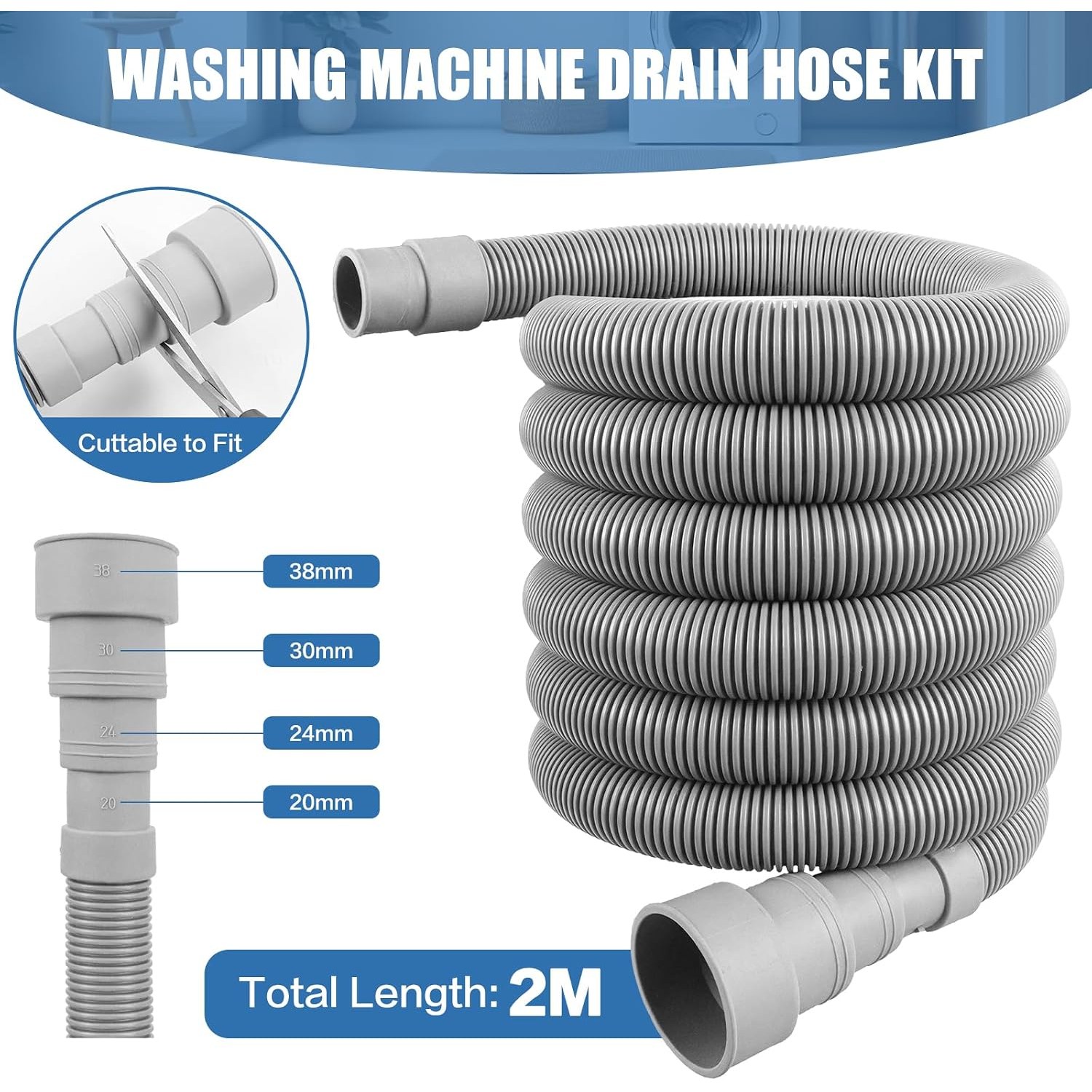
The first is the hose. It is 2 metres long and made from polypropylene, a plastic often shortened to PP. The colour is grey. The maker describes it as soft, which matters more than it sounds, because a drain hose has to be threaded through holes in the sides of cupboards and curved round the back of a machine.
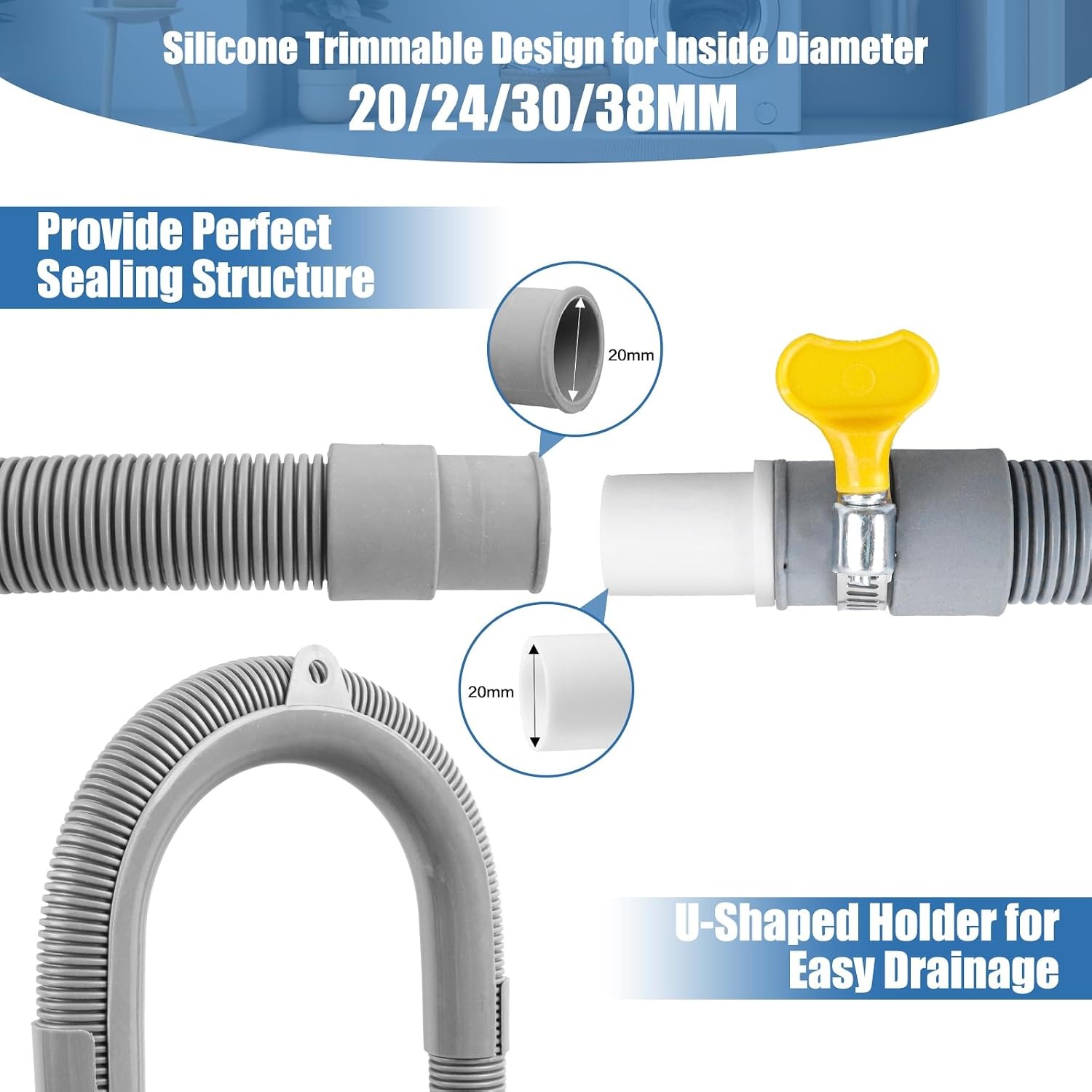
The second is an extension adapter. The maker lists it at 5.32 x 2cm. This is the piece that joins one hose to another, or the hose to a pipe.
The third is a U-shaped bracket measuring 15 x 10cm. It is a simple guide that holds the hose in a curve.
The fourth is a set of eight hose clamps.
The whole kit weighs 0.14 kg. The maker says nothing further is needed to fit it, though you will want a sharp knife and possibly a screwdriver.
Matching it to your pipework
Waste fittings are not all one size. An appliance spigot on a sink trap, the end of an existing hose and the top of a standpipe can all differ. A hose with one fixed end would suit some homes and not others.
This hose is made to be cut. The maker says it can be cut to fit pipe diameters of 20, 24, 30 or 38mm. You pick the size that matches what you are connecting to and trim the hose end to suit.
That makes measuring the first job. With the appliance switched off, find the point where the new hose will join. Measure across the fitting in millimetres. A ruler will do, though a set of callipers is better if you have one. Write it down.
If the figure is one of the four sizes, you are within what the maker lists. If it falls between two of them, do not force it. A joint that is too loose will weep however tight the clamp, and one that is too tight can split the hose.
The adapter has its own figure. The maker describes it as fitting waste pipes with an inner diameter of 20mm. The maker also lists an outside diameter of 20mm for the hose. The inner diameter of the hose is not stated by the maker.
We cannot confirm that the kit fits any particular make or model of appliance. Your own measurement is what counts.
Why the bend matters
The U-shaped bracket looks like the least important part in the bag. It is not.
Where a drain hose meets a standpipe, it goes up, over and down, like a walking stick handle. That high loop does a real job. It keeps water in the drum until the pump sends it out. If the end of the hose sits too low, water can siphon out of the machine as it fills. The machine keeps filling, the water keeps leaving, and the wash never finishes.
Soft hose does not hold that shape on its own. Left alone it sags, flattens at the bend or slides down into the standpipe. The bracket holds the curve open and at the height you set.
Your appliance manual gives the correct height for the hose end, as a minimum and a maximum. Use those figures. They differ between machines.
How far you can extend
Two metres of extra hose is generous. That does not mean every machine can use all of it.
The water is moved by a small pump in the base of the appliance. It was sized for the hose the machine came with. Add a long extension, particularly one that rises on the way, and the pump has more work to do. Past a certain point it cannot clear the drum in the time the programme allows, and the machine reports a drain fault.
The limit is in your appliance manual, usually as a maximum total hose length. Check it before you start. If you need less than the full 2 metres, cut the hose down. A shorter, straighter run always drains better than a long one coiled behind the machine.
Keep the route simple as well. Avoid tight turns. Do not run the hose where the machine will stand on it or where a drawer runner will rub it.
Fitting it
Switch the appliance off at the socket and turn off its water supply. Pull it out far enough to work behind it. Put an old towel and a shallow tray on the floor, because the existing hose will have water in it.
Lay the new hose along its route before you cut anything. Mark the length you need, with a little slack for pulling the machine out in future.
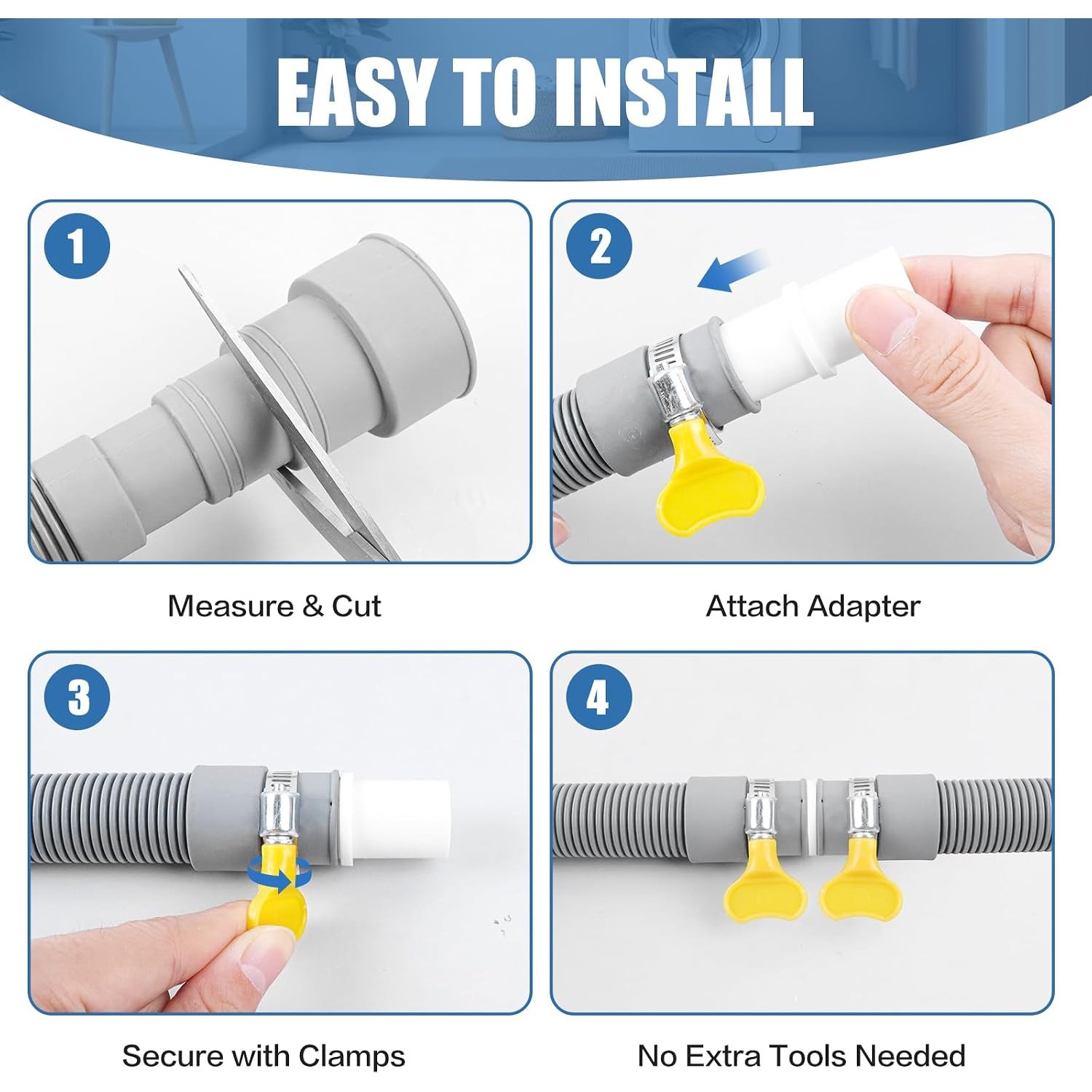
Trim the hose end to the size that matches your fitting. Cut squarely with a sharp knife. Join the hoses with the adapter, pushing each side fully home. Put a clamp on each side of the joint and tighten it until it is firm. Do not overdo it, as plastic can be crushed.
At the far end, fit the U-shaped bracket and hook the hose into the standpipe. The hose should sit loosely in the pipe and not be sealed into it, so air can get in around it.
Now test. With the machine still pulled out, run a rinse or drain programme and watch every joint while the pump runs. Feel underneath each one for drips. Only when everything is dry should the machine go back into its space. Look again after the next few washes.
When it is a plumber's job
Joining a hose to a standpipe or an appliance spigot that is already there is a householder's task.
It stops being one when the pipework itself has to change. If there is no standpipe where you need one, if the trap under the sink has no spare appliance connection, or if the waste pipe has to be extended or rerouted, that is altering fixed pipework. It is a job for a qualified plumber, and the Irish Building Regulations apply to drainage work.
One more point on where the water goes. Appliance waste belongs in the foul drain. It should never be run to a rainwater gully or a pipe that takes roof water. If you are unsure which is which at your house, ask a plumber before you connect anything.
And remember this is a drain hose. It carries waste water away. It is not a water inlet hose, which works under mains pressure and has threaded connectors.
Looking after it
A drain hose needs very little. A few times a year, pull the machine forward and look at it. Check each joint is dry. Check there are no kinks, cracks or flattened sections. Make sure the hose is still seated in the bracket and the standpipe.
Detergent and fabric softener can leave a grey sludge inside a hose over time. If the hose starts to smell or the machine drains slowly, switch off, unhook the hose over a bucket and flush it through with hot water. A long flexible brush will shift anything stubborn. We do not recommend chemical drain cleaners.
Keep the spare clamps somewhere you will find them.
The short version
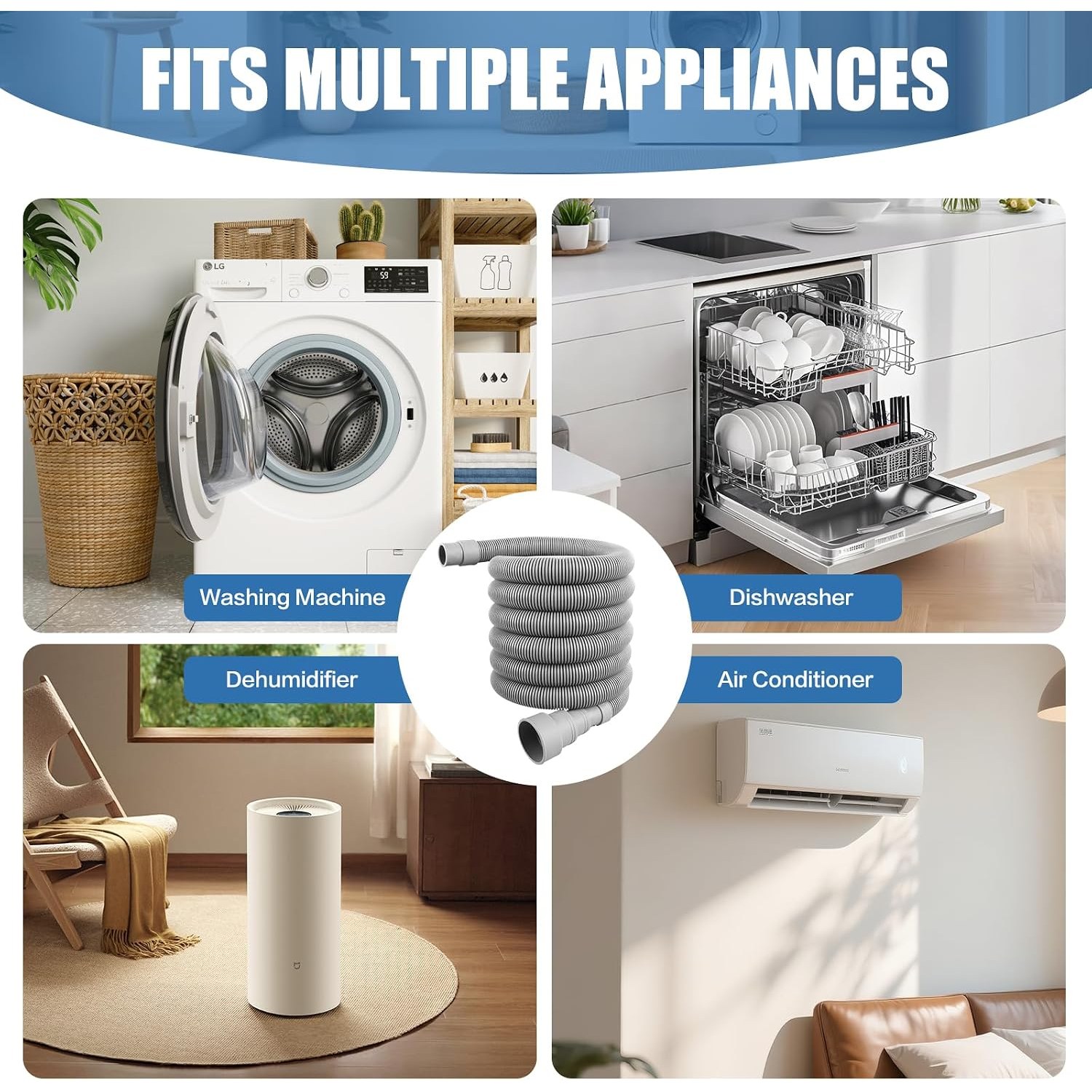
When an appliance sits too far from its waste, extend the hose properly. This kit gives you a 2 metre grey polypropylene hose, an extension adapter, a 15 x 10cm U-shaped bracket and eight clamps. The maker says the hose cuts to fit 20, 24, 30 or 38mm, and lists washing machines, dishwashers, dehumidifiers and air conditioners as uses.
Measure your fitting first. Check your manual for the maximum hose length and the right height for the hose end. Clamp every joint and test before pushing the machine back.
If the waste pipework needs changing, bring in a plumber.