
The complete guide
How To Extend A Washing Machine Drain Hose
When the hose will not reach
Washing machines and dishwashers come with a drain hose fixed to the back. It is long enough for the usual spot, right beside the waste pipe under the worktop. It is rarely long enough for anywhere else.
So the trouble starts when something changes. You move the machine to the far side of the utility room. A new kitchen puts the dishwasher two units away from the sink. You buy a replacement appliance and its outlet is on the opposite side to the old one. Suddenly the hose stops a metre short.
People try all sorts at this point. They stretch the hose tight, which pulls on the fitting at the back of the machine. They drag the appliance out at an angle. They prop the hose end in a bucket. None of that is a fix.
The proper answer is to extend the hose with a second length and a sound joint. That is what this kit is for.
What is in the kit
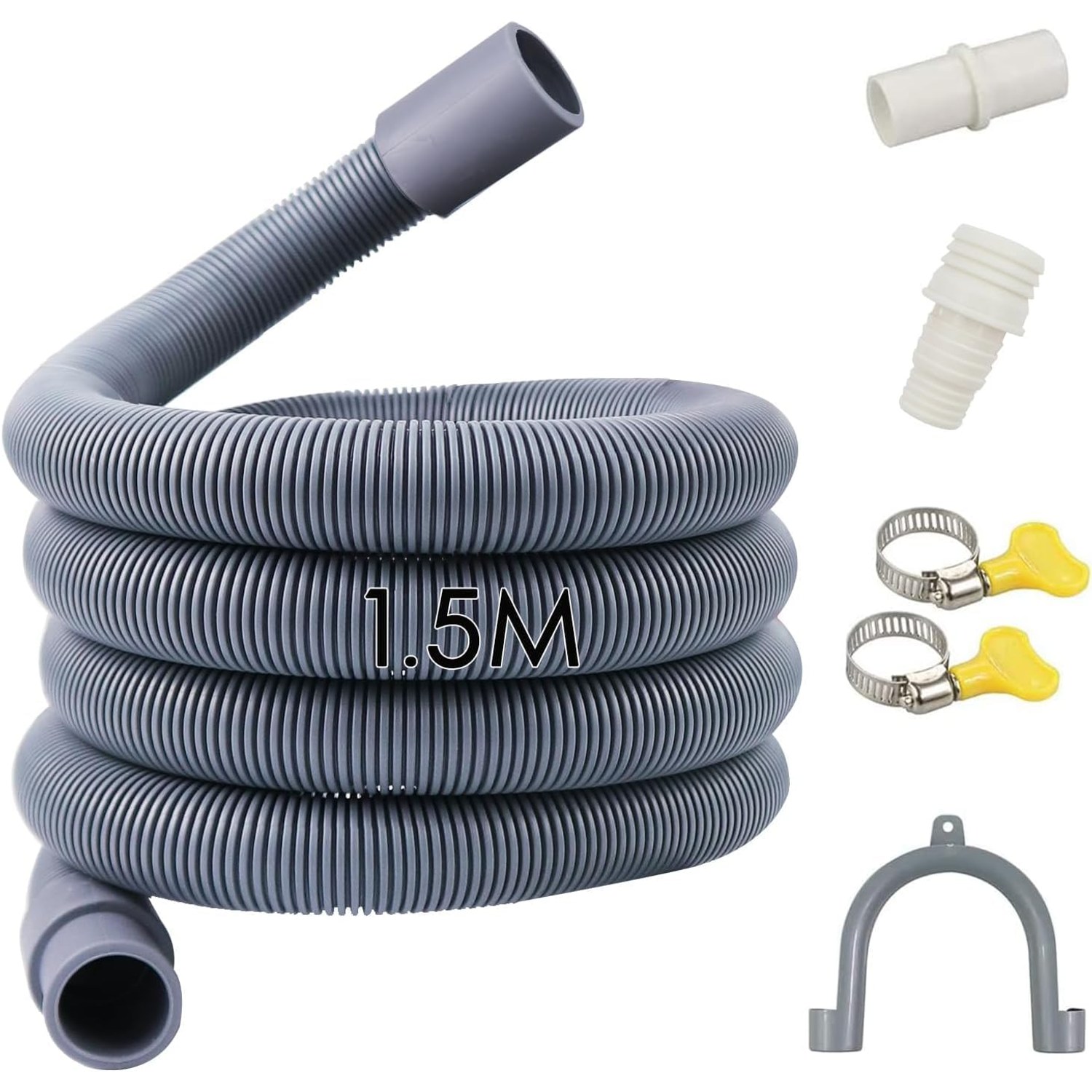
The maker lists the contents plainly. There is a 1.5 metre hose, also given as 59 inch. There is a U-shaped bracket. There is an extension connector, a 30mm adapter and two hose clamps.
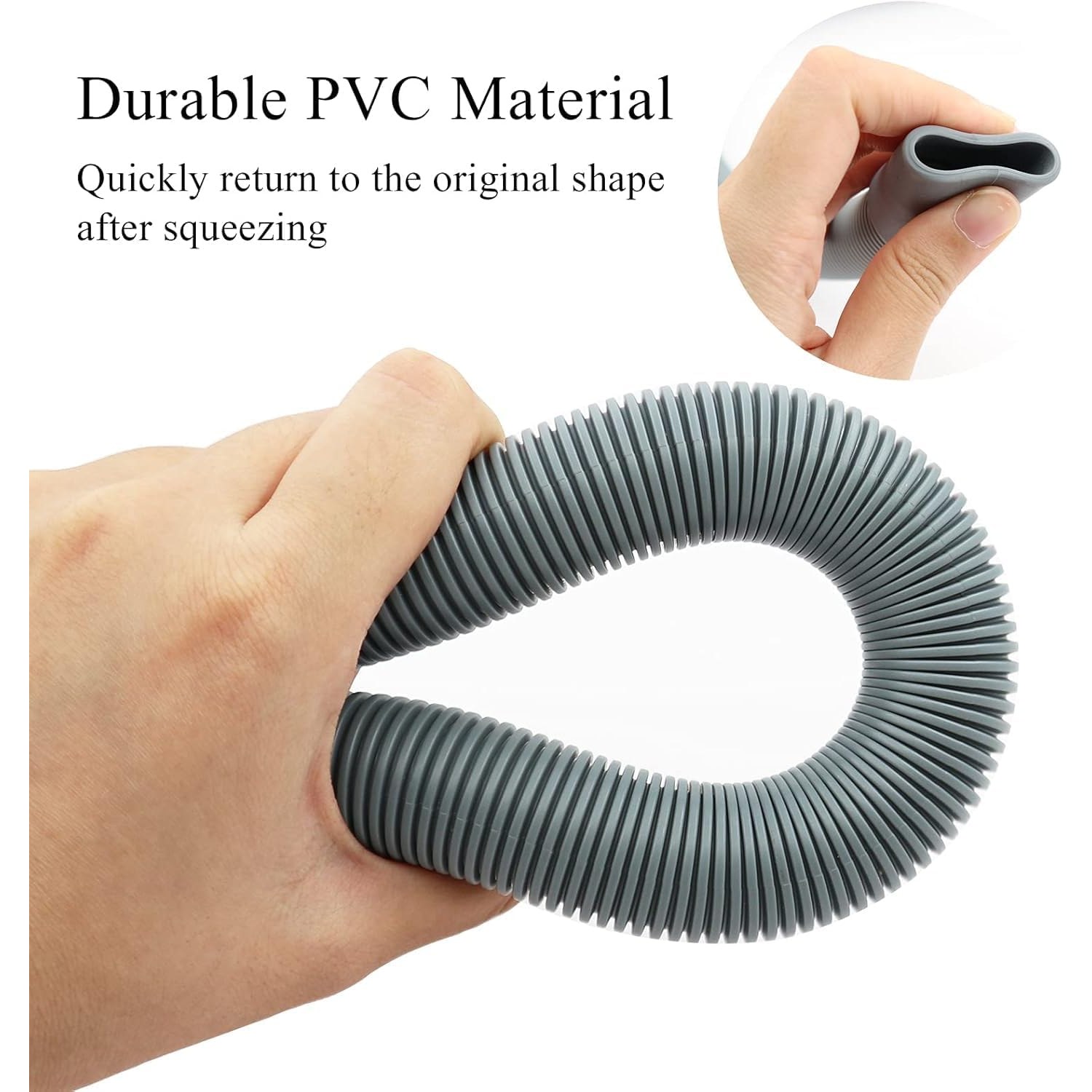
The hose is grey and the maker describes the material as polypropylene, a common plastic. The kit weighs 0.12 kg.
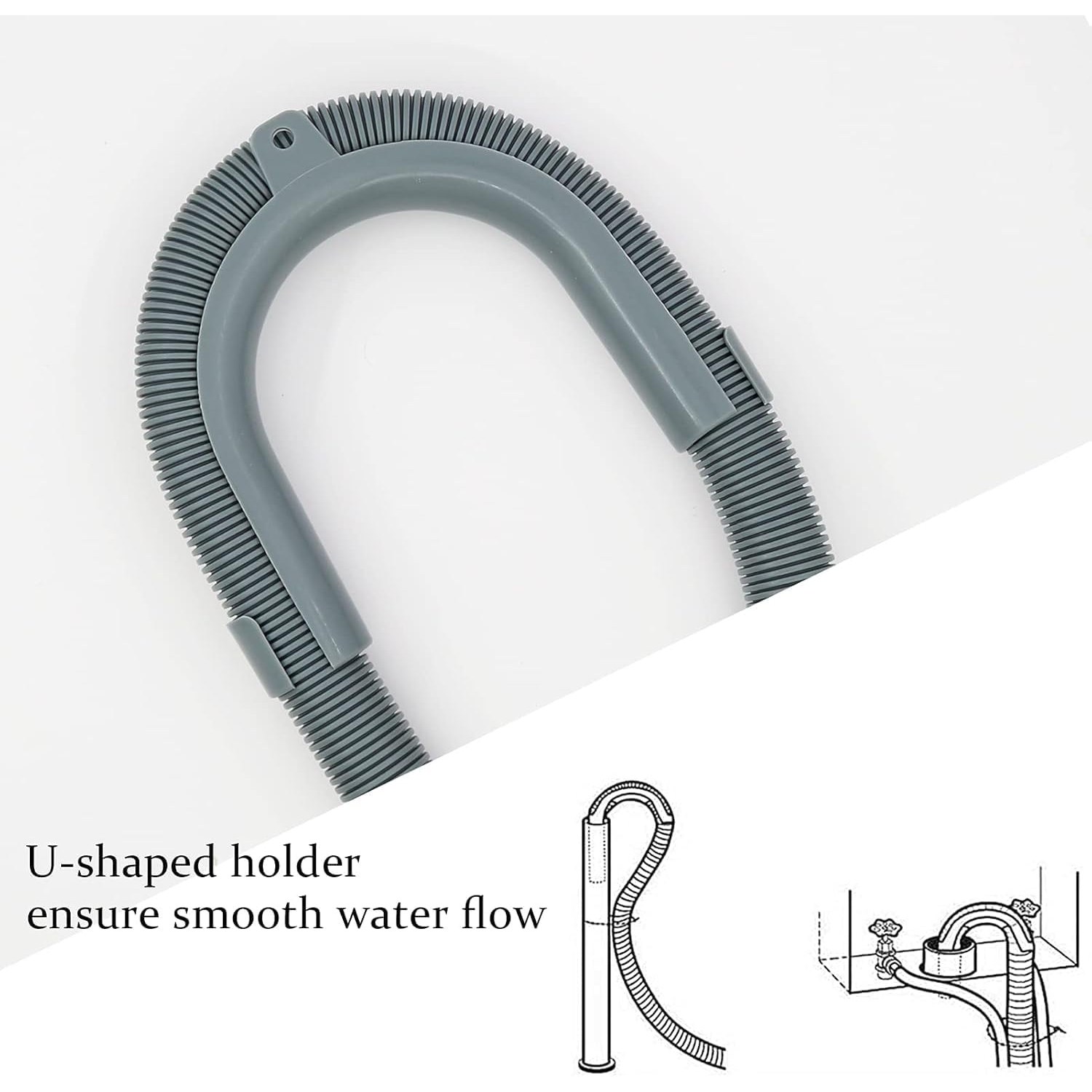
Each part has a job. The hose gives you the length. The connector is a short rigid piece that sits inside the two hose ends where they meet. The clamps squeeze each hose end down onto the connector so it cannot pull off or weep. The 30mm adapter is for a join to a 30mm pipe. The U-shaped bracket holds the far end of the hose in a curve so it can hook over a standpipe.
The material of the clamps and the bracket is not stated by the maker.
Getting the sizes right
This is the step that decides whether the kit works for you, so take five minutes over it.
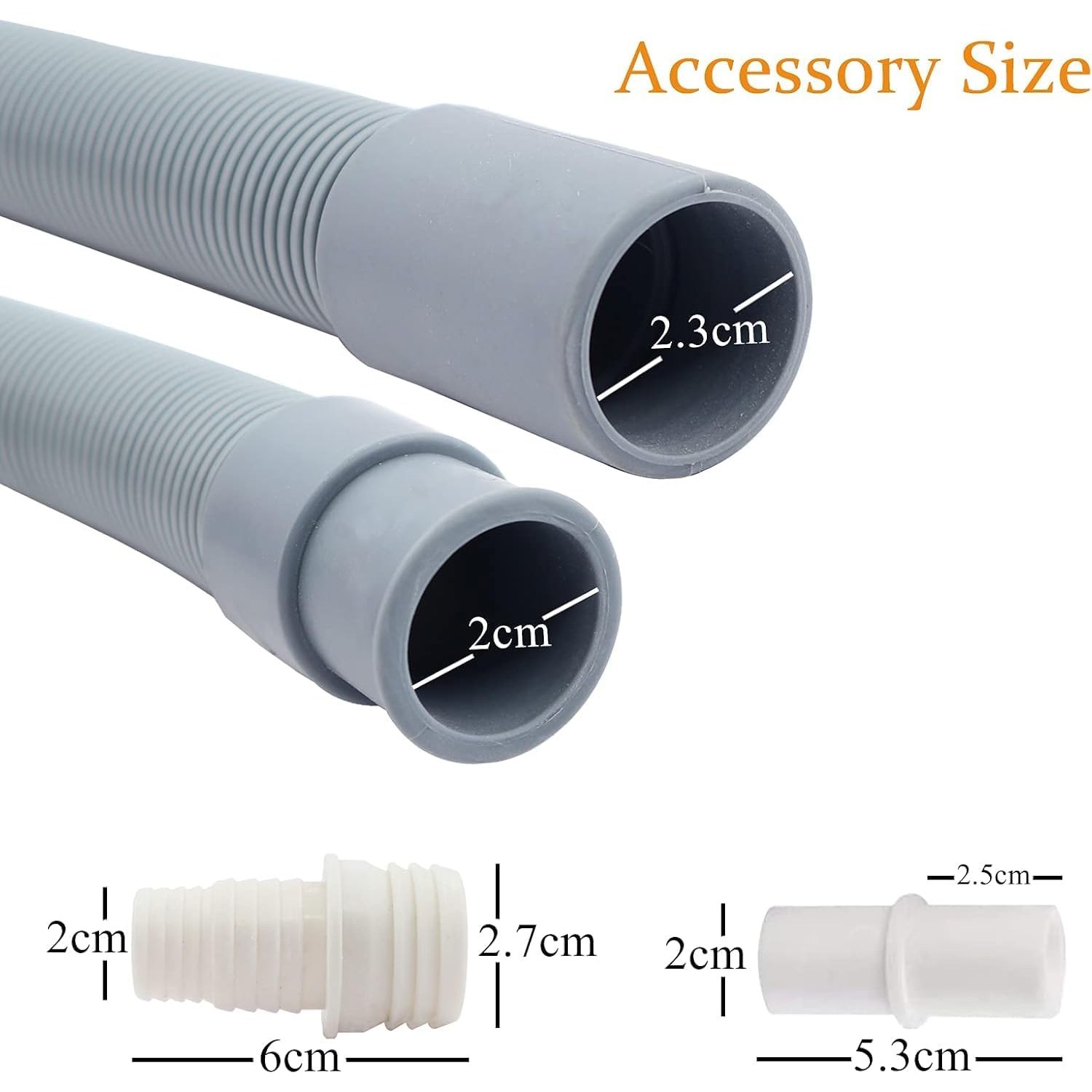
The maker gives the inner diameter at the hose ends as 20mm or 23mm. The white connector is 21mm across, and the maker describes it as suiting a hose with a 20mm inner diameter. The 30mm adapter is for connecting to a 30mm pipe. The maker also lists an outside diameter of 30mm and a wall thickness of 2mm, without saying which part of the hose those figures refer to.
Now look at your own appliance. Pull the machine forward and find the free end of its drain hose. Measure the inside of that end with a ruler or, better, a set of callipers. If it is close to 20mm, the connector should push into it snugly.
Then look at where the water is going. Is it a standpipe, a spigot on the sink trap, or another hose? Measure that as well.
The maker asks buyers to confirm their pipe size before purchase. We would say the same. Drain hoses are not all one size, and no kit suits every machine. If your figures do not line up with the ones above, contact us before ordering.
Joining the two hoses
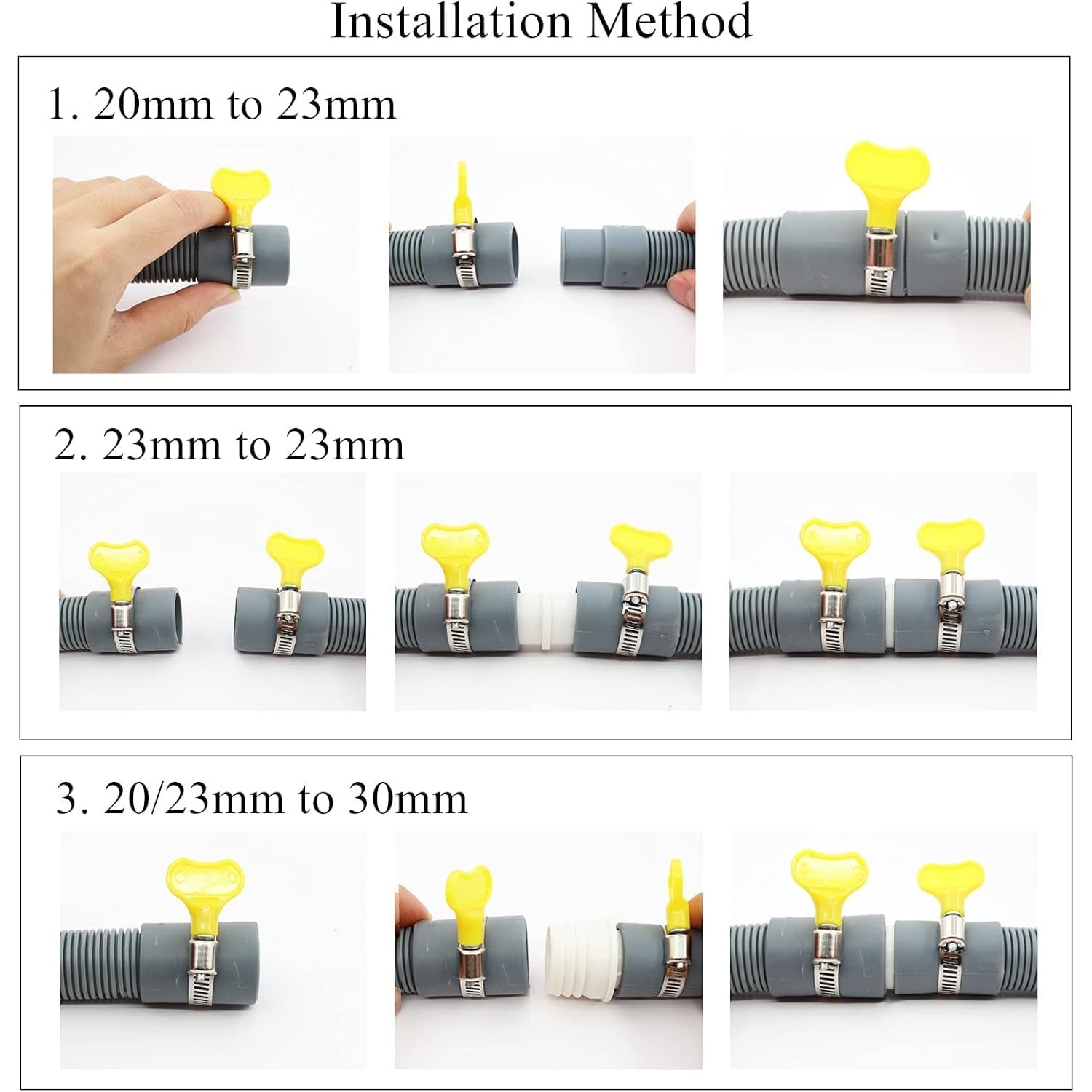
The maker describes the fitting as a push fit that needs no tools, done without taking the existing hose off the appliance. The type of clamp is not stated, so keep a screwdriver or pliers within reach in case the clamps need a final tighten.
Start by unplugging the appliance. Put an old towel on the floor, because the existing hose usually holds a little water.
Slide one clamp over the end of the existing hose and one over the end of the new hose. Do this first. It is annoying to make the joint and then find the clamps sitting on the worktop.
Push the connector into the end of the existing hose until it is fully home. Push the new hose onto the other half of the connector. Both hose ends should meet, or nearly meet, in the middle.
Move each clamp so it sits over the part of the hose that is on the connector, and tighten it. The clamp should be firm enough that you cannot twist the hose on the connector by hand.
Where the far end meets a 30mm pipe, fit the 30mm adapter there.
Hooking up the waste end
The other end of the new hose goes to the waste. In most Irish homes that is a standpipe, an upright pipe with a trap at the bottom, or a spigot on the trap under the sink.
For a standpipe, push the U-shaped bracket onto the hose end. It holds the hose in a hook shape. Hang that hook into the top of the standpipe. The hose should sit a short way into the pipe, not jammed deep down it. There needs to be an air gap around the hose so the machine cannot siphon.
Height matters too. Every appliance manual gives a minimum and maximum height for the hose end. Too low and water can drain out of the drum by itself during a wash. Too high and the pump cannot lift the water. Find the page in your manual and follow its figures.
Lay the remainder of the hose in gentle curves along the wall or the back of the units. Avoid kinks. Do not let the machine sit on the hose or squash it when you push the appliance back.
Do not go too long
It is tempting to think more hose is always fine. It is not.
The drain pump in a washing machine or dishwasher is small. It is built to push water a certain distance and up a certain height. Add too much hose and the water slows, the machine takes longer to empty, and it may stop with a drain fault.
Your appliance manual states the maximum total length of drain hose. Add the length of the hose already on the machine to the 1.5 metres in this kit and check the total against that figure. For the same reason, we would not join two kits end to end unless the manual clearly allows it.
The first wash
Do not push the machine back and walk away. Test the joint first.
Leave the connector where you can see it. Put a dry sheet of kitchen paper under it. Run a short rinse or a drain cycle. Watch while the pump runs, because that is when the joint is under load.
If the paper stays dry, you are done. If there is a drip, tighten the clamps a little and run it again. Check once more after a week of normal use, and then every few months.
What needs a plumber
Extending a hose and hooking it into a standpipe that is already there is a fair job for a householder. You are not changing the pipework.
Anything beyond that is different. If there is no standpipe where the machine is going, one has to be installed. That means cutting into the waste system and fitting a trap. That is a job for a qualified plumber, and the Irish Building Regulations apply to drainage work.
A plumber will also make sure the water ends up in the right place. Waste water from a washing machine or dishwasher belongs in the foul waste system. It should not be run out through a wall into a rainwater gully.
One more point on safety. This is a drain hose. It is for waste water leaving the machine under the gentle push of the pump. It must never be used on the inlet side, where hoses carry mains pressure.
Looking after it
A drain hose needs little attention. Check the joint now and then. Look for kinks after anyone has moved the machine. Keep the hose away from sharp edges and from anything hot.
If the machine starts draining slowly, fluff or detergent residue may have built up. Unplug the appliance, undo the joint over a bucket and rinse the hose through with warm water. We do not recommend chemical drain cleaners for this or any other drain.
The short version
When an appliance drain hose is too short, extend it properly. This kit gives you a 1.5 metre grey polypropylene hose, an extension connector, a 30mm adapter, a U-shaped bracket and two hose clamps.
The maker gives the end inner diameters as 20mm or 23mm, with a 21mm connector for a 20mm hose. Measure your own hose before you buy.
Clamp both sides of the joint, hook the end at the height your manual states, keep within the manual's maximum length, and watch the first cycle for drips. If you need a new standpipe or any change to fixed pipework, call a qualified plumber.